Tod Slaughter, or, Marriage Is a Business Proposition

Here’s the opening lecture for the British Horror Film course that I taught a few years ago and would very much like to revisit soon.

I want to use this opening statement as an opportunity to both frame this week’s readings and obliquely introduce tonight’s film, Dead of Night (1945; dir. Alberto Cavalcanti, et al.).  For those of you who know a little bit of the history of horror films, 1945 will likely have struck you as being really rather late in the game for a national cinema to begin making its first discursively effective forays into horror.  After all, Universal Pictures in the U.S. had begun cranking out sound horror films fourteen years prior to Dead of Night, and it’s not like these Universal horror shows went unnoticed by film-makers and –viewers of the world.  Tod Browning’s Dracula (starring Bela Lugosi) appeared in New York in February 1931, while James Whales’s Frankenstein (starring Boris Karloff as the monster) showed up in U.S. theatres in November and December of the same year.  Both films promptly got UK releases (Dracula in 1931 and Frankenstein in 1932), and both had extremely successful exhibition runs throughout Britain as well.  In fact, if you believe many of the popular and scholarly histories of the British film industry in the 1930s, then you could say that these Universal attractions perhaps proved too successful, insofar as the incredible popularity of these films in the U.K. made a target of the horror film genre for many outraged members of the community, from clergy members, local councils, and members of Parliament to child protection societies, morality councils, and (eventually) the British Board of Film Censors itself, which instituted an advisory classification for horror films (“H”) in January 1933 (less than two years after Dracula premiered in Britain).  While not yet an official form of certification (like the “U” and “A” certificates), an “H” classification was nevertheless grounds enough for some cinema chains and local councils in the U.K. to refuse to exhibit any movie with that classification.  By June 1937, this advisory classification became an official certificate—that is to say, if your film got an “H” certificate after that date, then only adults could watch it in cinemas (meaning that it functioned much like the NC-17 rating does in this country today).  In 1942 “H” films were banned outright by the British Board of Film Censors, and only with the end of hostilities in Europe were horror films allowed to be imported, made, certified, and exhibited.

Now what this admittedly hasty and slapdash account of the pre-history of horror films in the U.K. would have you believe is that the British Board of Film Censors first muted, then restricted, and finally altogether smothered the potential for the discursive founding of a native horror tradition in British cinema before 1945.  Therefore, in response to the question, Why does it take horror so long to get started in Britain?, the answer would seem to be something along the lines of, Because the censors made it so damn awful hard to do so before 1945.  Now I certainly do not want to dispute the proscriptive efficacy of the British Board of Film Censors as a historical datum—that is, I do not at all want to be understood as denying that Britain has tended to have one of the more fussily active institutional bodies independently overseeing and censoring film and video production and exhibition in the West.  Yet even though I grant all that, I do not want you to take away from this weekend’s reading or from this course the notion that this is a story of artist-heroes and hypocritical villains, with the dastardly British Board of Film Censors taking their shears to defenseless works of art that have now come down to us brutalized and maimed.  Texts and their producers are not as helpless as all that—they are not more done to than doing, as it were.  More axiomatically expressed, I want to advance the claim here that censorship could not have (nor did it) prevent the expression of horror images and effects in 1930s British cinema.  At most, the British Board of Film Censors forced filmmakers to develop and hone techniques of representing and embodying horror between the lines.

Consider, in this respect, the following scene from the first sequel to Universal’s Frankenstein, James Whales’s Bride of Frankenstein (1935).  The scene we’re about to watch ought to have a haze a familiarity around it for you, even if you’ve never seen a Frankenstein film, because it’s one of those bits of horror-film discourse that got around a lot in the 1930s and then stuck around for a few decades more.  In a word, this is one of those iconic laboratory scenes from the Frankenstein series, in which we get to see all sorts of flashing lights, high voltage traveling arcs, hasty switch- and lever-pulling, and (as it turns out) a bit of Ben Franklinesque kite-flying during a dramatic thunderstorm.  Take a look:

At the level of first impressions, what we have here is a pretty impressive montage of evocative mise-en-scene, dutch camera angles, and hyperbolically lit close-ups, all in the service of representing for us the labor (and the division of labor, I would add) that goes into re-animating a composite corpse in the sequel to Frankenstein.  Whereas in that earlier film, Dr. Henry Frankenstein managed to create his first monster with only one assistant (Fritz) and without any kites whatsoever, in Bride of Frankenstein Henry gets press-ganged into imparting life into the monster’s prospective mate by Dr. Pretorius (he’s the white-haired chap wildly tossing switches and iconically posing before travelling arcs and mini-explosions throughout the lab set), who evidently requires the assistance of two cronies as well, Karl and Ludwig, who can be found manning the kites on the edges of the frame in the rooftop shots.  There’s a lot to be said about this doubling (doubling of laborers and their scientist overseers, doubling of monsters, etc.), but for our purposes here let it suffice to say that this scene seems invested in showing us that an awful lot of collective male laboring goes into making a spectacle out of the making of a woman outside of the womb.

Now let’s compare this lab work scene to a strikingly similar one that pops up four years later in George King’s The Face at the Window, a British melodrama set in Paris that was released in cinemas five months before war was declared on Germany.  All you need to know by way of exposition before we dive into the scene is that this is the film’s climax, in which the unjustly maligned protagonist, Lucien Cortier, reveals that the aristocratically untouchable Chevalier Lucio del Gardo (played by the wonderfully campy Tod Slaughter, but more on him later) is in fact responsible for the various crimes and murders that have been wrongfully blamed on Lucien.  Lucien uses the laboratory of one of his scientist friends to re-vivify a recently murdered man (Lucien’s scientist friend himself) so that this dead man can live again long enough to write out the name of his murderer.  Here’s what it looks and sounds like:

The citationality of this scene ought to be self-evident, but it’s worth rehearsing some of these bits of shared discourse and working through what similarities and differences there are and what those relationships might mean if they meant anything.

For starters, what we seem to be presented with here is Frankenstein on the cheap:  instead of huge sets whose axis of orientation tends toward the neck-achingly vertical, with electric current spraying downward onto the scuttling figures of our two laboring scientists (anti-hero and anti-anti-hero, as it were) from a long phallic device extending from an ostentatiously thunderstruck rooftop exterior, we have here instead a flattened, fairly non-descript and self-contained room, free of the high voltage travelling arc sprays so prominently and repetitively displayed in Bride of Frankenstein, though this downscale set is not entirely without its own assortment of the laboratory essentials every mad scientist needs, from flashing lights, spinning wheels, bubbling beakers, curly-cued wiring, and (as it happens) a peal of thunder.  As if to underscore this rinky-dinkness of the lab’s equipment, you’ll note that nobody in the scene pays all that much attention to it.  Unlike Bride of Frankenstein’s Henry and Pretorius, who can’t stop looking at all the cool and dangerous-looking stuff going on around them and who never really get around to looking at the creature they’re in the midst of studiously reanimating, everyone in The Face at the Window is wrapped up with staring down the object of all this scientific labor, the supposedly revivifying hand of Lucien’s dead scientist friend.  To be sure, as in Bride of Frankenstein, the action here gets punctuated with a variety of close-ups of the actors’ faces, although here the structural roles doled out to the figures seen up close are not those of scientific mastery so much as those of engrossed spectatorship—even Lucien, the putative scientist-figure here responsible for these effects, is (by scene’s end) shown to be just as much a passive witness to the proceedings as everyone else, with his and their close-up shots alternating in a faster and faster rhythm with close-ups of the hand of the “corpse” slowly coming back to life to write out Lucio del Gardo’s name.

In short, the lab in The Face at the Window gets represented to us as a theater calculated to achieve certain spectatorial effects (tensions get heightened, the possibility of fright at the prospect of a “real” reanimated corpse gets raised, and Lucio del Gardo gets forced into dropping the innocent aristocrat act)—that is to say, it is not a space in which scientific labor as such really (or diagetically) gets done.  Maybe Lucien’s dead friend’s experiments with corpses really do work, maybe they don’t—the film doesn’t really care because it is finally revealed that the corpse hand belongs to a very real and very much alive person and not to Lucien’s dead scientist friend.  If the start of this scene seems to place us in a Frankenstein film on the cheap, we end it in a Frankenstein film with its tongue swelling out its cheek.  That is to say, the unimpressiveness of Lucien’s lab equipment doesn’t look like a function of Spartan budgetary constraints by the end of the scene so much as it seems to be of a piece with the film’s mode of interpreting and re-presenting in a thoroughly debunking spirit that which Frankenstein and its Universal-derived brood have wrought.  If The Face in the Window really does offer us its lab-as-a-theatre-of-effects, then those effects are structured so that the narrative build-up to what the film thinks ought to scare you has a complementary (and perhaps even obligatory) let down into something like laughter.[i]

Now what I want to demonstrate in the remainder of this opening statement is the extent to which horror passage-work in 1930s British film tends on the whole to exhibit precisely this have-your-cake-and-eat-it-too quality, which is to say that it often strives to reproduce the discourse of “American” horror even as it all the while seeks to debunk it.  To speak more particularly, we could note that there seems to be a pseudo-realist impulse subtending this scene from Face at the Window, in which the possibility of their really being something like scientific necromancy gets represented and then quickly dissolved in hilarity (hilarity that is itself further punctuated by a very real gunshot though not by really good marksmanship).  Somewhat reductively, this apparent preoccupation with debunking the possibility of their actually seeming to be re-animated corpses in a British (as opposed to an imported American) film can be made to look like a form of self-censorship.  Following such an approach out a bit further, one could even go so far as say that it is by means of just such a debunking spirit that Face at the Window can perhaps be seen to already be doing the British Board of Film Censors’ job for it.  The problem with debunking, however, is that there is no stop button for it.  In other words, we could just as easily ask ourselves whether or not Face at the Window’s parodic take on horror (which we can perhaps re-phrase by saying that what the film thinks ought to scare you ought not be so real as to fail to make you laugh all the same) doesn’t comment on and/or debunk the film as a whole, an operation I want to test out by hurriedly looking at clips from two other films.  The hunch or thesis here, therefore, goes something like this:  we should trouble any interpretation of debunking as a one-way street leading ineluctably to self-censorship in those 1930s British films that happen to have horror passages by noting instead that contemporary censorship forces in the U.K. seem to have elicited pressures within texts like The Face at the Window, which itself can be seen to be pushing back against these forces and these pressures in a way that makes ambiguous or ambivalent that text’s discursively-marked horror images and putatively strived-for horror-effects.  That’s a mouthful, and the simple way of saying it is this:  censorship does not produce distorted texts but instead makes more complicated ones not only possible but perhaps even necessary.[ii]

Another way to put this would be to say that what censorship does to British horror in the 1930s is make it exhibit a laterality it might otherwise not have had, and the scene we’ve just watched performs this intertextual agility for us in a neat way:  what starts to look like Frankenstein instead simply turns out to be a plain (and all-too-mundane and diagetically-motivated) gambit aimed at getting Tod Slaughter’s Lucio del Gardo to reveal his guilt.  Detection, not horror, is the narrative’s ostensible aim; a preoccupation with epistemology, not affect, would appear in turn to be the cover story it presents to its audiences.  It is important, however, to insist that this story is just a cover.  As in all these movies, we know from the beginning who the hidden bad guy is:  it’s Tod Slaughter.  He’s the mystery the heroes are trying to solve, and since we the audience are in on the game from the beginning, the main interest for us isn’t detection per se, but pleasure—specifically the pleasure of seeing just how much Tod Slaughter can get away with and how much fun he can have while getting away with it until the inevitable unmasking scene occurs.  Therefore, taking a step back from this text and looking over the field of British film production in this period in general, we can extrapolate from this scene and sum up the situation as follows:  if you want to make a British horror film between 1933 and 1945, then you do so by making use of the materials and forms of other genres to which the stink of the “H” classification or certificate does not yet stick.  In other words, in order to present British audiences with horror effects in British films, you start out by making a melodrama or a mystery or a comedy in which horror passages can be inserted, protracted, called forth, and/or ironically emplotted within these more socially acceptable narratives and materials.  If this is in fact sums up the situation of horror in the U.K. before 1945, however, it does not prescribe for us how these horror passages function in any given film from that period.  That is to say, we still have to attend closely to individual cases.  Interpretation does not go away; it just has a few more orienting cues to look for and go by.

Now there are many examples I can give you in the interest of fleshing out this claim with textual support demonstrating possible models of how to make use of it in an interpretation, but rather than move ahead to British war-time comedies and melodramas, I want to stick with Tod Slaughter and make my case by taking a closer look at some of his cinematic output from the mid-to-late 1930s.  Born Norman Carter Slaughter in Newcastle-Upon-Tyne in 1885, Tod Slaughter made his name in the 1920s managing and starring in Victorian melodramas staged at the Elephant and Castle Theatre.  After leaving the Elephant and Castle, he took his repertoire on tour into the suburbs and provinces, and then in 1935 (at the age of 50) Slaughter began starring in film adaptations of many of those wildly successful plays with which he had become increasingly identified in British popular culture over the past decade or so:  in his first two films, he reprised his roles as villain in Maria Marten, or The Murder in the Red Barn (1935) and then in The Demon Barber of Fleet Street (1936) (where, as Sweeney Todd, he “polishes off” a number of unsuspecting wealthy men who were just looking for a shave).  He followed these two films up with five more Victorian melodramas:  The Crimes of Stephen Hawke (1936), It’s Never Too Late to Mend (1937), The Ticket of Leave Man (1937), The Face at the Window (1939), and Crimes at the Dark House (1940).  These films present us with a remarkably unified set of texts.  All seven were produced by George King, all appear to be pro forma Victorian morality tales with vice punished and virtue rewarded, all star Tod Slaughter as the villainous embodiment of eventually punished (but more often than not gloating) vice, all (with the exception of The Crimes of Stephen Hawke) are based on plays or novels written in the nineteenth century, and all pretty much serially repeat the same plot, which basically hinges on Tod Slaughter’s villain doing a lot of bad things under the protective covering offered by his vast wealth and/or upstanding public reputation before a boring young male protagonist finally manages to unveil to the community Slaughter’s responsibility for all the naughty things perpetrated in the film (robbery, fraud, rape, adultery, murder, etc.), thus sending Tod Slaughter off to prison (or, as the case may be, to his death) and thereby preventing the boring young heroine from either marrying or staying married to this old ham-actor cad who means her no good.

Now I want to spend what little time we have left giving you a sense of what this all looks like, of what the experience of watching a Tod Slaughter film unfold feels like, in order to show to you the degree to which horror passage-work in 1930s British melodramas, mysteries, and comedies was not necessarily made safe or neutralized thereby for the benefit of vulnerable British audiences.  The thesis I am advancing here, you will remember, is that horror debunks as much as it is debunked in these ‘30s films—that is to say, these films may exhibit many features that seem to act to undermine the potency of the images or situations they think ought to scare you (think of the “corpse” in The Face at the Window popping up to smile and say, “That’s where you’re wrong”), but this debunking process can work both ways, meaning that we have to ask ourselves why a comedy, mystery, or melodrama needs to so ostentatiously perform the neutralization of its horror passages in the first place.  That is, what are these texts really scared of.

With this thesis in mind, let’s cycle through some of the highlights of one of the best Tod Slaughter melodramas, Crimes at the Dark House, which is adapted (though that verb ought perhaps to be put in scare quotes) from Wilkie Collins’ famous mystery novel, The Woman in White, first serialized between 1859 and 1860.  In the interest of time, I’m going to keep my commentary here to a minimum, but I will punctuate some of the scenes with some cues for you to follow as we work our way to the grand finale.  The film starts in fine homicidal fashion:

With the real Sir Percival Glyde staked through the ear canal and with the signet ring and letter now in his possession, Tod Slaughter’s Aussie gold-digger assumes the identity of the baron and makes his way back to England, where he gets an interesting reception from the help:

Here we have a good example of a key recurring feature in these Tod Slaughter Victorian melodramas, which has to do with the issue of complicity.  As the scene unfolds it becomes increasingly unclear the degree to which Mrs. Bullen, the housekeeper, is all that unaware of the fact that Slaughter ain’t exactly who he purports himself to be.  That is, if Slaughter is the key figure of vice in these films, he is never the only such figure because around him there always happen to be a variety of people aiding and abetting him in (as well as benefitting from) his shameful deeds.  More on that in a minute.

You’ll have noticed that Slaughter’s faux Sir Percival Glyde takes an instant lip-licking and claw-clutching liking to the parlor (now chamber) maid, Jessica, and the ups-and-downs of this relationship provide a counterpoint of sorts to the main plot, which concerns Slaughter’s plans to marry a wealthy young woman because the estate he thought he was inheriting when he killed off the real Sir Percival Glyde has (as it turns out) little more than debts to bestow upon him.  The upstairs-downstairs erotic pursuits undertaken by the bogus Sir Percival Glyde and Jessica also link up pretty explicitly with the title figure from Wilkie Collins’ novel, the woman in white, who is the legitimate daughter of the murdered Sir Percival Glyde and who has escaped from a local asylum to harass Slaughter’s hammy impersonation of a debt-ridden aristocrat.  Consider the following:

Let’s hold on to the observation, “Marriage is a business proposition,” because that’s a claim that has a future in these films.  For now, though, we can take a look at how things turn out for Jessica:

Two things are worth noting here:  (1) Slaughter’s “bride of death” quip was a tag-line that would have been familiar to contemporary audiences, as it was used in Slaughter’s first film, 1935’s Maria Marten, or Murder in the Red Barn, thus making its appearance here function somewhat like an act of self-branding (it’s Slaughter’s “I’ll be back,” as it were); (2) the murder of Jessica in the old boathouse by the lake links back up with the woman in white subplot quite explicitly once the false Sir Percival Glyde takes to the notion of getting rid of the woman in white’s mother (and the secret wife of the dead Sir Percival Glyde), Mrs. Catherick, using a ploy that will now be familiar to us:

With these two emblems of illicit and/or hidden sexuality out of the way, the sham Sir Percival Glyde can pursue in earnest his plans to marry Laurie Fairlie and dispossess her of her fortune.  But marriage is not simply a business proposition, nor is it wholly without its spectators, from fantasizing servants to the obstructing woman in white herself:

What this second scene in particular makes clear is the degree to which married sex not only starts to look like rape but (more particularly) appears to be not altogether unlike the sort of horror film with which we are all more familiar, with the alternating shots of Tod Slaughter’s feet (slowly ascending the stairs, slowly crossing the floor), Laurie Glyde’s (née Fairlie’s) cowering face, and the bedroom door as it creakingly opens all suggesting to us now (more than seventy years after the fact) the composite elements of a proto-slasher film as it were.  Perhaps most importantly, however, this sequence suggests that the horror passage-work in these 1930s Tod Slaughter films functions as a critical commentary on marriage and sex, and (I would add) it would probably be overly hasty to see these films as safely restricting their horror-show critiques simply to Victorian marriage and sexuality.  In this view, the horror passage-work in these melodramas do not simply punctuate the elaborately moral narrative with reliably containable bits of pleasure; instead, the horror passages here debunk the contrivances of those narratives by implying that determinations of virtue and vice are beside the point to begin with.  That is to say, if we take seriously the “horrific” operativity of a figure like those of Tod Slaughter’s villains within the societies these films represent, then the implication seems to be that there is not much moral uplift in the narratively belabored downfall of vice and the heroic rise of virtue because both changes in station seem utterly inconsequential, insofar as these events leave untouched the social arrangements and institutions that go on taking the mere appearance of wealth and social respectability at their word.

In other words, if horror has a function in these Tod Slaughter melodramas, then it is that of ruffling surfaces—the surfaces people present to each other in these films, the surfaces these texts in turn present to their viewers, and the socially prescribed and accepted surfaces that normative sexuality would appear to present to the world in the seemingly more manageable form of marriage, which we can no longer take straight as it were.  In this sense, then, I would argue that the climactic unmasking scene in It’s Never Too Late to Mend offers us the truth of horror in these Tod Slaughter melodramas, for it offers us a doubled unveiling, with vice doing to virtue what virtue normally does to vice:

Two things deserve passing mention here:  first, the dramatic entrance of the reverend who successfully prevents the discharging of a bullet from Tod Slaughter’s gun with his demonstrative brandishing of a cross would seem to make Slaughter’s sadistic aristocrat in this film into a vampire, into Dracula as it were; second, despite the unveiling of Slaughter’s bad deeds here, marriage in the end nevertheless continues to prove to be a business proposition.  That is to say, the young lovers can marry now because the boring young man is filthy with money, which means he can materially benefit the sorry state of the boring young woman’s family’s finances, the principal impediment to their not having tied the knot earlier in the film.  So slight is the uplift in the punishment of vice represented here that one is tempted to take Tod Slaughter at his word and treat his maniacal refrain (“He’ll break your heart / He’ll break your heart”) as the debunking message of horror in this film and perhaps in the all the 1930s Slaughter melodramas as well:  not vice punished and virtue rewarded, but male vice showing male virtue up for the vice it really is or badly wants to be underneath its superficially respectable surface.  In a nutshell, what these Tod Slaughter melodramas really think ought to scare you is how much fun it is for men to do really awful things to women who cannot do anything but submit to those same awful things.  Like marriage, for instance, Victorian or otherwise.


[i] My attention to what a horror film thinks ought to scare you is entirely dependent on the work of H. Marshall Leicester, Jr., whose book on horror is forthcoming. Likewise, my understanding of the horror genre and my ways of interpreting it owe a great deal to years and years of watching movies with Marsh and Evan Calder Williams. I should also note here that Marsh and Evan were my co-instructors for the first iteration of this course.

[ii] An introductory lecture for a film course is no place to pursue this point much further, but it should be noted that this way of approaching the effects of censorship goes at least as far back as Leo Strauss, who develops this claim by looking at the works of notable heterodox Jewish philosophers. See Leo Strauss, Persecution and the Art of Writing (Glencoe, IL: Free Press, 1952).

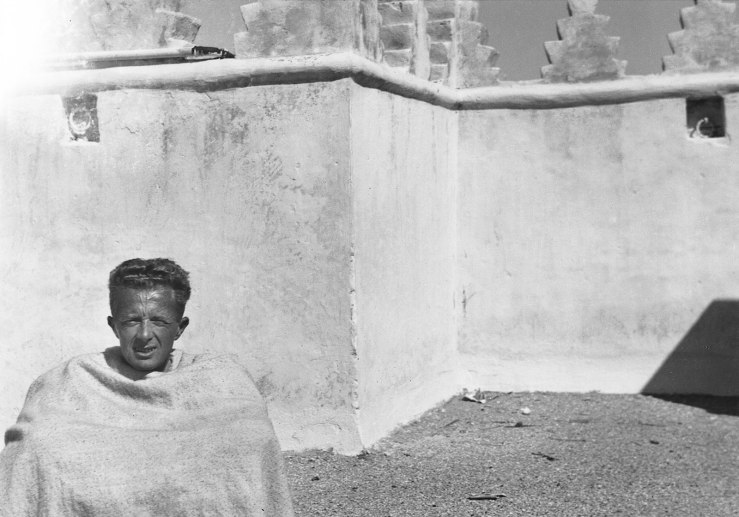
The Man in the High Castle

Lange

Hot winds blowing me who knows where. This is vision—of what? Can the animus endure this? Yes, the Book of the Dead prepares us: after death we seem to glimpse others, but all appear hostile to us. One stands isolated. Unsuccored wherever one turns. The terrible journey—and always the realms of suffering, rebirth, ready to receive the fleeing, demoralized spirit. The delusions. (Philip K. Dick)

When Fez Fell

This is an essay that was to be included in an edited volume on Paul Bowles that regrettably ended up not coming out.

Bowles

More than five years before Morocco declared its independence, Paul Bowles published an article detailing the singular pleasures awaiting the Western visitor to the walled city of Fez in a July 1950 issue of the travel magazine, Holiday.  Accompanied by eight sumptuous black-and-white photographs depicting its shaded patios, narrow alleyways, mid-day meals, fritter vendors, pottery merchants, public scribes, medina gates, and well-born women (“veiled like sedate ghosts”), Bowles’s “Fez” reels off the pastoral sights, nocturnal sounds, dinner rituals, and complimentary hashish of this “ancient Moroccan city” and important “religious citadel of Islam.”[i]  “Fez,” his article begins, “is a city whose site was chosen purely for esthetic reasons” (13).  In the account that follows one gets the impression that Fez indeed comprises a desirable but tenuous aesthetic experience for Bowles, who strives to capture its specificity through the numerous sensory claims being made on the body of the adventurous traveler by the city’s inhabitants, bare earth, storks, straw, thya wood, latticework, perfumes, mint, textiles, ripe figs, and donkeys before modernity catches up with them and they speed off in the back of a rickety Renault bus.  Thus, he approvingly quotes the remarks of an old resident of Fez, Sidi Driss el Yacoubi, who claims never to have even seen an automobile: “‘What good is it?  The wheels go around fast, yes.  The horn is loud, yes.  You arrive sooner than on a mule, yes.  But why should you want to arrive sooner?  What do you do when you get there that you couldn’t do if you got there later?’” (13).  In reply to his own questions, the old Fassi laughs and goes on to cite the Qur’an, for there is no hope that “Western civilization” can evade “a fate which is predetermined, ‘written’ as they put it in Arabic” (13-14).

However, not everyone in Fez feels as Sidi Driss does about the emergent relationships between modernity and Islam, and throughout the remainder of the article, Bowles obliquely discloses some of the immanent threats to the medieval charms of this stimulating city.  On the one hand, there are the “modern-minded, bourgeois Fassi,” who possessively divvy up ancient homes upon the death of their fathers with unsightly, windowless walls and make a point of presenting their wives, mothers, slave-girls, and daughters to Westerners during house calls, in the interest of conveying the progressiveness of their thinking (17).  On the other, there are the college- and seminary-educated youths, whose “overwhelming obsession is to do away as speedily as possible with whatever is specifically Moroccan.  However, their loyalties remain wholly within the Moslem world; they are not interested in becoming Westerners.  Cairo is their idea of a really civilized place” (20).  Interestingly, according to Bowles’s article, the French colonists do not pose much of a danger to the preservation of Fez because they have decided to quarter themselves many miles from the city in “typical colonial-exposition style,” now gone to seed: “It is a depressing spot, a potpourri of broken windows, peeling paint, cracking concrete, wheezing old automobiles, short-tempered Frenchmen and begging native children—a hideous contrast to the soothing homogeneous beauty of the old city” (20).  If anything, the French Quarter is essential to the aesthetic pleasures of Fez itself, for its slum-like qualities show off the attractive features of that walled city and its residents all the more effectively: unlike the French, the “Fassi have always known how to live—they still do. . . . There is a complete lack of nervous tension in [their] life, an utter ignorance of what it means to be bored, all of which makes for a satisfaction in existence, a thing that very few Westerners are able to attain” (22).

The emblem of such a satisfaction that is still available to the Western traveler and to which Bowles returns more than once in his account of Fez and Fassi life is the experience of being led against one’s will by a servant through the labyrinthine passageways within the old city late at night after a long, drawn-out dinner.  In part, having a guide is necessary for navigating this space after dark because “many of the inner gates across the passageways that serve as streets are regularly closed at night, so that the man who has stayed out late and wants to take short cuts to get home often finds he must go all the way back to where he started and try another route” (14-16).  Even should one want to walk blindly through Fez, “a polite host will never let his guest depart unaccompanied. . . . It may be several miles and one may complain that one prefers to go alone; there is no escape; the other will be adamant.  He remains until the end, and you both go uphill and down in the darkness—through tunnels, across bridges, nearly always accompanied in the nocturnal silence by the faint sound of running water behind the walls, until you reach your door” (16).  Later in the article, Bowles describes another guided trek through Fez at night, this time after he has eaten some hashish:  “The expedition lasts forever, but I do get home somehow, even though it is not before the visions have already begun to project themselves on the moonlit walls around me as I stumble along” (20).  In total darkness and sobriety, it is the barely audible water that lingers with the traveler to Fez, while high on hash in the full moonlight it is the vivid visuality of the ancient Fassi cityscape that stands out “like an early movie, when in order to make a night sequence they printed scenes shot in sunlight on blue film” (20).  Regardless of whatever impression the first sentence of Bowles’s article leaves on the reader, one finishes “Fez” with a clear sense that the city certainly is a site that this accomplished travel writer chooses to visit and describe for purely aesthetic reasons.

Bowles would return to the city of Fez five years later in his third novel, The Spider’s House (1955), which details not the bodily experiences evoked by this ancient Moroccan city but rather the “dissolution” of the “traditional pattern of life” among the Fassi during the nationalist struggles of the mid-1950s.[ii]  Focalized through a shifting cast of Moroccan and American characters, the third-person narrative focuses a great deal on the relationship between expat writer John Stenham and an illiterate young Fassi boy named Amar, who is a cherif, a descendent of the Prophet Mohammad’s cousin and son-in-law, Alī ibn Abī Ṭālib.  Stranded outside the walls of the city soon after the French begin their reprisals on local insurrectionary forces opposing the removal of Sultan Mohammed V from the throne, Amar joins up with Stenham and Polly “Lee” Burroughs, a bemused American tourist and supporter of the anti-colonial violence breaking out before her very eyes.  Over the next few days, Stenham and Burroughs carry on their volatile and ideologically-driven debates over the merits of the Istiqlal (Independence) Party and nationalist movements in general as this unlikely trio make their way into the mountains to witness the communal observance of Eid al-Adha (Festival of the Sacrifice), a Muslim religious holiday commemorating Abraham’s readiness to sacrifice his son, Ishmael, at Allah’s request.[iii]  Banned by Istiqlal until Sultan Mohammed V returns to the throne, Eid al-Adha and its illicit celebration miles from Fez allow Stenham and Amar to converge in their anti-nationalist opinions as the American is amazed to learn that the young cherif actually comports himself in accordance with Qur’anic law, something which is totally alien to Stenham’s conceptions of Moslems up to this point.[iv]

In particular, Amar’s genuine religious piety leads Stenham to wonder privately whether Moroccans are in the end all that different from Westerners, who themselves are not “inexorably conditioned by the pressure of their own society” but capable of exhibiting “individual variations”: “But in that case the Moroccans were much like anyone else, and very little of value would be lost in the destruction of their present culture, because its design would be worth less than the sum of the individuals who composed it—the same as in any Western country” (336).  What Amar disrupts, in other words, is Stenham’s sense of the representability of such a thing as a “Moslem,” “Moroccan,” or “Fassi,” for what this young native informant comes to constitute for him is a singular difference that his thoughts on regional, national, and religious alterity cannot quite seem to assimilate.  Given money by Burroughs to buy a pistol so he can fight alongside his fellow rebellious Moroccans, Amar later inadvertently aids the escape of a group of nationalists outside of Fez before returning to the Americans’ hotel, where he accepts a reluctantly offered ride from Stenham and Burroughs.  The two Americans have implausibly consummated their contentious relationship and are making a break for it to Casablanca.  Somewhere on the Meknès road, they tell the boy that he cannot accompany them to where they are going.  Forced to leave the car, Amar runs after them:  “Now for a moment he had the exultant feeling of flying along the road behind the car.  It would surely stop.  He could see the two heads in the window’s rectangle, and it seemed to him that they were looking back” (406).  The car passes from view, however, and in a poignant re-staging of Sidi Driss’s comments in the earlier travel article on Fez, the conclusion of The Spider’s House shows Amar arriving sooner, thanks to Polly and Stenham’s automobile, at his seemingly predestined fate:  standing alongside the road in the middle of no place one would want to be alone.

As this speedy and selective précis suggests, the resonances between Bowles’s Fassi article and his Fassi novel are multifaceted.  As the book’s chief exponent of the aesthetic appreciation of Fez, Stenham repeatedly echoes that article’s anxieties concerning the precarity of the city’s particular charms, threatened most of all by the forces of modernity, whether they are to be found among the French or (perhaps even more likely) the Moroccan nationalists themselves: “When this city fell, the past would be finished.  The thousand-year gap would be bridged in a split second, as the first bomb thundered; from that instant until the later date when the transformed metropolis lay shining with its boulevards and garages, everything would have happened mechanically” (167).[v]  Not surprisingly, then, the novel’s opens with Stenham in a suggestively familiar situation; namely, that of failing to convince his Fassi dinner host that he does not need a servant to lead him back to his hotel.  Unable to account for why his Berber guide will not let him talk or turn on a flashlight as they gropingly negotiate the nighttime passageways of Fez, Stenham muses privately over how the alterity of Moslems is merely a product of cultural differences, of “ritual and gesture,” neither of which “give their perceptions any profundity,” just as the rituals and gestures of Fassis make them a “feline, nocturnal people” (6).  Along the way Stenham momentarily loses himself in the heightened sensory environment he both listens and contributes to as he and the guide traverse Fez at night:

There were places where his footfalls were almost silent, places where the sound was strong, single and compact, died straightaway, or where, as he advanced along the deserted galleries, each succeeding step produced a sound of an imperceptibly higher pitch, so that his passage was like a finely graded ascending scale, until all at once a jutting wall or a sudden tunnel dispersed the pattern and began another section in the long nocturne which in turn would slowly disclose its own design.  And the water was the same, following its countless courses behind the partitions of earth and stone.  Seldom visible but nearly always present, it rushed beneath the sloping alleyways, here gurgled, here merely dripped, here beyond the wall of a garden splashed or dribbled in the form of a fountain, here fell with a high hollow noise into an invisible cistern, here all at once was unabashedly a branch of the river roaring over the rocks (so that sometimes the cold vapor rising was carried over the wall by the wind and wet his face), here by the bakery had been dammed and was almost still, a place where the rats swam. (7)

The “faint sound of running water” referred to in “Fez” gets expansively developed by The Spider’s House into an indexical series (“here . . . here . . . here . . . here . . .”) of fussily distinguished and cataloged sounds (gurgle, drip, splash, dribble, hollow fall, roar) that not only notate an ongoing passage through a dark, variegated space but also act as accompaniment on the soundtrack provided by Stenham’s modulating footsteps.  Walking at night in Fez seems to be even more of a stimulating experience than Bowles’s travel article had intimated five years earlier.

Yet Stenham’s nocturne with footsteps and water is not allowed to develop beyond his return to the hotel.  Waiting for him there is news that the Moroccan nationalist movement that he has successfully kept from his mind throughout the night is about to disrupt his Fassi aesthetic reveries once and for all: “The only feeling of which Stenham could be conscious at the moment was a devout wish that he had not knocked on the door, that he could still be standing outside in the dark where he had been five seconds ago” (12).  In turn, his overblown and self-aggrandizing reflections on the general character of Moslems and Fassis during the walk back to the hotel, which were occasioned by his Berber guide’s supposedly perverse refusal to let him talk or turn on his flashlight, now appear bitterly ironic.  Stenham has been too self-absorbed to have noticed that the elaborate efforts of his guide to maintain silence and darkness on the circuitous journey to the hotel were life-preserving.  After all, there is an anti-colonial struggle that is about to get even more violent throughout Morocco and the Maghreb, and to be a Westerner easily mistakable for a Frenchman wandering about the crooked alleys and byways of Fez after midnight at this particular moment in history may be decidedly hazardous to one’s health.  In the prologue to The Spider’s House, Stenham walks through Fez thinking he is in a Paul Bowles travel article and is disappointed to find himself situated instead within the much more complicated Fez of a Paul Bowles novel.

At a surface level, then, what this intrusion of violence and history into the American’s recognizable aestheticization of Fez indicates within the first few pages of The Spider’s House is that Bowles has a canny sense of genre distinctions in his writing.  In the 1958 essay, “The Challenge to Identity,” he asks, “What is a travel book?”, and his answer remains illuminatingly straightforward: “For me it is the story of what happened to one person in a particular place, and nothing more than that; it does not contain hotel and highway information, lists of useful phrases, statistics, or hints as to what kind of clothing is needed by the intending visitor. . . . The subject-matter of the best travel books is the conflict between writer and place.  It is not important which of them carries the day, so long as the struggle is faithfully recorded.”[vi]  What matters in travel writing, in other words, is the individual’s fidelity to the subjective reactions, reflections, and experiences actually evoked by a foreign “place,” not his or her capacity to reflect the objective facets (facts, numbers, barometric pressures) of such a site.  A faithfully reproduced interiority is the measure onto which readers can hold as we assess the confrontations of the traveler with new sights, sounds, people, and experiences: “A reader can get an idea of what a place is really like only if he knows what its effects were upon someone of whose character he has some idea, of whose preferences he is aware” (361).  In this regard, then, the Stenham we encounter in the prologue to The Spider’s House certainly plays by the rules of the Bowlesian travel writing game, exotifying and generalizing in ways that may be spurious or partial but that are no less authentically subjective for all that.

What differentiates the novel, however, is the fact that, unlike the travel book, it unavoidably raises the problem of achieving an inter-subjective relationship between text and reader that Bowles doubted was possible in the first place.  As he notes in his 1972 autobiography, Without Stopping, “Long ago [i.e., the mid-1940s] I had decided that the world was too complex for me ever to be able to write fiction; since I failed to understand life, I would not be able to find points of reference which the hypothetical reader might have in common with me.”[vii]  For Brian T. Edwards in Morocco Bound (2005), this denial of shared orientations between himself and readers of his novels was part and parcel of Bowles’s protracted “refusal of the American literary context that was his necessary point of reference in the four books of fiction he published between 1949 and 1955.”[viii]  Focusing on this early period in Bowles’s career as a fiction writer, Edwards compellingly articulates the ways in which such a refusal informs his compositional practices as a novelist, which are simultaneously late modernist and geopolitically engaged.  Exemplary of such Janus-faced practices in The Sheltering Sky (1949) are said to be Bowles’s linguistic and narrative strategies for interrupting and distancing “American reading subjects from the developing political relationship to the Arab world that deeply informed [his] novel and was thickly woven into the political and economic fortunes of the United States.”[ix]  In particular, Edwards singles out the interruptive functions served both by The Sheltering Sky’s use of untranslated Maghrebi Arabic and by its shift in narrative focus to Kit’s relationship with Belqassim following Port’s early death in that book.  According to Edwards, these paired interruptions not only have the potential to break up the coherence of the American national subject but also to bring out the difference of Maghrebi subjects in ways otherwise foreclosed by the frames of nationalist thinking: “As Bowles’s case demonstrates, there are American authors of the 1940s-1970s whose work sits uneasily within the hypernational framework of the period. . . . [the] departure [of their work] from the national episteme helps rethink the relationship between cultural production and foreign relations.”[x]

Consequently, the task for the critic of a Bowles novel (rather than of a Bowles travel article) becomes the explication of how the interruptive techniques of his fiction possibly shape geopolitical subjects and representations that are not at all reducible to a continuum running from anti-imperialism to neocolonialism and back again.  I submit that Fredric Jameson’s controversial remarks on national allegories in “Third-World Literature in the Era of Multinational Capitalism” (1986) are in fact crucial for how such disruptive potentialities might be understood to operate in The Spider’s House.  As Jameson notes in the opening pages of that article, even classifying the works he looks at as examples of “third-world literature” is a provocative gesture because the three worlds theory itself seems to presuppose the effacement of important national and regional differences between a variety of non-western countries.  This becomes especially evident when comparing the contexts and texts of China and Senegal, the two “third-world” sites on which Jameson focuses most of his attention.  Nevertheless, what ultimately draws him to the descriptive merits of the three worlds model is that, unlike theories of the “global south,” it does not efface systemic differences between capitalism, real existing socialism, and the heterogeneously mixed social modes of organization to be found in all the countries of the third world, which are said to be “in various distinct ways locked in a life-and-death struggle with first-world cultural imperialism—a cultural struggle that is itself a reflexion of the economic situation of such areas in their penetration by various stages of capital, or as it is sometimes euphemistically termed, of modernization.”[xi]  The impression that this situation leaves on the cultures produced by the third world in the Cold War era necessitates the annulment of the first-world split between “the private and the public, between the poetic and the political,” between “the domain of sexuality and the unconscious and that of the public world of classes, of the economic, and of sexual political power,” between Freud and Marx: “although we may retain for convenience and for analysis such categories as the subjective and the public or political, the relations between them are wholly different in third-world culture.  Third-world texts, even those which are seemingly private and invested with a properly libidinal dynamic—necessarily project a political dimension in the form of national allegory: the story of the private individual destiny is always an allegory of the embattled situation of the public third-world culture and society.”[xii]

This is not the place to replay the attacks on and defenses of Jameson’s allegorical linkage of libidinal apparatuses to the public relationships of economics and politics in the third world.[xiii]  However, to the extent that it is possible for one to bracket the prescriptive dimensions of his argument, the case can be made that Jameson’s descriptions of the effects that “third-world literature” has on “first-world readers” are frequently staged and disrupted throughout The Spider’s House.  In fact, the interruptive project that Edwards understands to be informing Bowles’s early fiction manifests itself most clearly in the ways in which the novel establishes, resists, and decomposes the efficacy of all such allegorical frameworks in narrating Morocco’s transition from colony to nation-state.

Perhaps the most obvious point of contact between Jameson’s essay and Bowles’s novel is the enactment of the first-world split between private and public that we encounter in the figure of Stenham.  Crucially, given the Cold War context informing Jameson’s remarks, this division in Stenham is no mere datum or neutral experience in itself but rather is the product of a tortuous history of de-radicalization shared by many Americans who came of age politically in the 1930s.  Often understood to be paradigmatic in this regard is the trajectory traced by Partisan Review, the journal in which Bowles first published the short story, “A Distant Episode,” in early 1947.  In fact, according to one of his biographers, it is precisely because Partisan Review accepted this especially grim tale that Bowles was able to feel that “he had achieved literary acceptance sufficient to merit a career as a writer,” which suggests that the magazine was a formative point of reference as he transitioned from music to fiction.[xiv]  As it tried to cope with the Popular Front, the Spanish Civil War, the Great Purge, and the Moscow Show Trials, Partisan Review evolved from a fellow-traveling publication in the mid 1930s to a dissident Communist forum that also influentially defended modernist and avant-garde art in the late 1930s and early 1940s, after which point it became more or less reconciled to a capitalist world order because U.S. hegemony increasingly appeared to be the lesser evil facing democracy in light of the threats posed to it by real existing socialism.[xv]  To be sure, the crude simplicity of this arc is complicated, but by no means belied, by the lives and careers of the writers, critics, and intellectuals associated with the early volumes of Partisan Review.  Thus, the road-to-Damascus-like conversions to conservatism and liberal anti-communism of Sydney Hook and Lionel Trilling, respectively, may stand out sharply against the more protracted and in some cases elusive adjustments in the political commitments of critics as diverse as Philip Rahv, Dwight Macdonald, or Clement Greenberg, though even these finely drawn distinctions still end up telling us the same old story, which is that of the rightward lurch of the heterodox Left from the late 1930s onward in the U.S.[xvi]

Rahv’s essays in particular make comprehensible the disorienting diffusion of political position-taking among the figures connected to Partisan Review in the aftermath of the disenchanting events and revelations of the 1930s.  In fact, the sobering assessments made by Rahv in “Trials of the Mind” (1938) following news of the continuing purge trials help to articulate how the separation of the individual from radical political activity took place among many U.S. intellectuals, fellow-travelers, and (as Stenham and Bowles themselves once were) members of the Communist Party.  Because of the emergence of totalitarian trends within Party itself, Rahv’s essay argues that now the “historic process must be conceived on the plane of tragedy.  To regard it as melodrama is to believe that it yields to accident, cunning, and heroics.  On a provisional scale such yielding may occur; none the less within the final implacable summation the impurities are dissolved and the interventions repulsed.  In acting, man takes liberties; but only in recognizing as he acts the tragic nature of the forces that involve him does he gain freedom.  To endeavor to become the authors of the tragedy of history is utopian—all we can do is identify ourselves as its characters.”[xvii]  Not collective ameliorative change of man’s social conditions of existence but the individualizing recognition of one’s own inconsequence was seemingly the only revolutionary act left to Western fellow-travelers like Rahv, who felt able thereafter to harbor the illusion (at least for a time) that such a recognition itself made a more meaningful difference than that of actually existing socialism.

In other words, the tragedy evoked by Rahv has to do with how the first-world split between public and private noted by Jameson became a painfully lived experience for those intellectuals who were de-radicalized by Stalinism and the new world order that began to take shape following the war.  No longer able as a group to resolve the contradictions of social life, dissident American Leftists instead started to train themselves in the “deep cultural conviction that the lived experience of our private existences is somehow incommensurable with the abstractions of economic science and political dynamics.”[xviii]  The traumatic political content of the gulf opened up here may get elided by Port’s existentialist posturing in The Sheltering Sky, but Stenham’s predicament in The Spider’s House significantly depends upon his inability to think of this split between private and public in any other terms than those determined by Communism, the specter of which he sees everywhere in Morocco, from the Istiqlal Party to Polly Burroughs herself.  In fact, Stenham muses at one point over the possibility that the Communist Party is in fact ultimately responsible for the anti-colonial struggles breaking out throughout the Maghreb, making the Moroccan nationalists and the French colonialists little more than puppets of Moscow:

For the French had basically the same idea as the Nationalists; they quarreled only over externals, and even there he was beginning to wonder if these supposed disagreements were not part of a gigantic Machiavellian act, put on under the combined auspices of the French and Moroccan Communists in governmental positions, who, knowing better than anyone that before there can be change there must be discontent, were willing to drag the country to the verge of civil war in the process of manufacturing that discontent.  The methods and aims of the Istiqlal were fundamentally identical with those of Marxism-Leninism; that much had been made abundantly clear to him by reading their publications and talking with members and friends of the organization.  But wasn’t it possible that any movement toward autonomy in a colonial country, especially one where feudalism had remained intact, must almost inevitably take that road? (155)

Reflections of this sort recur punctually throughout those sections of The Spider’s House that are focalized through Stenham, whose thoughts consistently invoke a three-world system only to reduce it to one totalizing mess: “After all, he reflected, Communism was merely a more virulent form of the same disease that was everywhere in the world.  The world was indivisible and homogeneous; what happened in one place happened in another, political protestations to the contrary” (211).  At most, Stenham is willing to concede that perhaps “the West was humane” while “the East took suffering for granted, plunged ahead toward the grisly future with supreme indifference to pain” (211).

Despite this possible wrinkle in Stenham’s one-world epiphany, both capitalist modernity and socialist modernity are said to eventuate in the same cul-de-sac, to which his only response is a retreat into the private, into those “individual variations” that are singularly his.  Later Stenham reflects on how “[i]t would not help the Moslems or the Hindus or anyone else to go ahead, nor, even if it were possible, would it do them any good to stay as they were.  It did not really matter whether they worshipped Allah or carburetors—they were lost in any case.  In the end, it was his own preferences which concerned him.  He would have liked to prolong the status quo because the décor that went with it suited his personal taste” (286).  In other words, Fez ought to remain medieval because it is aesthetically pleasing to Stenham that way; the mistake, his reflections repetitively insist, would be to re-code his private aesthetic pleasure politically or socially because to do so would merely involve the re-incorporation of his very self into a world order in which he claims to have no part.  As he notes to himself during the forbidden celebration of Eid al-Adha in the mountains, Stenham “did not want the French to keep Morocco, nor did he want to see the Nationalists take it.  He could not choose sides because the part of his consciousness which dealt with the choosing of sides had long ago been paralyzed by having chosen that which was designed to suspend all possibility of choice” (342).

Perhaps most symptomatic of this lack of allegorical resonance between private choices and public side-taking in Stenham are his heated interactions with the American tourist, Polly Burroughs.  For most of the novel, theirs is an agonistic relationship in which they reliably face off against each other over the subjects of Communism, nationalism, anti-colonialism, Orientalism, U.S. foreign policy, and Islam, besides a multitude of other less timely topics as well.  The ideological contradictions of their points of view sharpen seemingly to the point of total irresolvability during Eid al-Adha, when Stenham witheringly interrogates Burroughs over her decision to give money to Amar with which to buy a pistol: “‘What does it feel like to have the power of life or death over another human being?’ he asked her suddenly.  ‘Can you describe it?’” (351).  Burroughs replies, “‘It must be exhausting to see everything in terms of cheap melodrama’” (351), after which point Stenham curses and leaves the tent in which they have been sitting.  Then something irreconcilable with the events of the novel and the development of their relationship up to this point occurs.  Stenham and Burroughs decide to make their peace and then make whoopee: “Almost immediately he came back in, clearly having been debating himself outside the entrance; his expression was determined, a little embarrassed, and he was shaking his head.  He walked over to her.  ‘God damn it,’ he said, sitting down again beside her, ‘why do we have to act like two six-year-olds?  I’m sorry if I’ve behaved badly. . . . After all, we got on all right with our differences of opinion before we saddled ourselves with that kid.  I don’t know why we shouldn’t be able to pick up where we left off.  Nothing’s changed, has it?’” (351).  Burroughs agrees, though she mentally notes that something has indeed changed.  They make arrangements to get back to Fez, have dinner, and then walk up to the top of a hill where “they sat quietly, and when he drew her to him, implanting a kiss first on her forehead, then on each cheek, and finally (so beautifully), on her lips, she knew it was decided, and she realized with some surprise that however eagerly he might be looking forward to the intimacies of love, she herself hoped for that moment with no less impatience” (352-53).

At least two essential things are worth noting here.  First of all, whatever allegorical significance credibly assignable to the ideological positions staked out by Stenham and Burroughs becomes thoroughly undermined by their erotic union at the end of The Spider’s House, where the decision to patch things up and start a romantic relationship together does not at all resolve the contradictions of their world-views.  Instead, these contradictions are revealed to be irrelevant to the singular and unaccountable choices that people make as private individuals.  As noted by Jameson, these two first-world subjectivities may be understood thereby to annul the allegorical referentiality between the “domain of sexuality and the unconscious and that of the public world of classes, of the economic, and of sexual-political power.”  The Spider’s House tantalizingly raises the possibility of the socio-political referentiality of Stenham and Burroughs’ interactions only to foreclose it by the narrative’s end.  The other thing worth holding on to from this passage is Stenham’s claim that it is Amar who is responsible for their delayed recognition of the primacy of the interpersonal over the social in the couple’s relationship together.  Implicit in this claim is a sense within Stenham that Amar somehow comprises a means of bridging this split between public and private, and tellingly what causes him to jump to this conclusion is his belief earlier in the novel that the young Fassi boy is indeed representative of the country as a whole.  He says to Burroughs at one point, “‘This kid is split right down the middle . . . You’ve got all Morocco right here in him.  He says one thing one minute and the opposite the next, and doesn’t even realize he’s contradicted himself.  He can’t even tell you where his sympathies are’” (285).  Thus, Stenham and Burroughs get hung up on their ideological differences because Amar fools Stenham into thinking that what they say and do has an allegorical significance opening out onto political and social levels of meaning.  In Jameson’s terms, as the necessarily allegorical subject of third-world literature, Amar reminds Stenham and Burroughs that the private need not be split off from the public ever and always.

As I indicated earlier in my summary of The Spider’s House, however, Stenham comes to reverse this interpretation of Amar after he discovers that the young cherif is not so riven with contradictory or hypocritical impulses as he had first assumed: “in that case the Moroccans were much like anyone else, and very little of value would be lost in the destruction of their present culture, because its design would be worth less than the sum of the individuals who composed it—the same as in any Western country.”  In other words, Amar eventually is the occasion for Stenham’s disorienting realization that not all Moroccans are equally representative of Morocco, that not all third-world subjects are inevitably allegorical figurations.  Remarkably, given the subtlety with which Bowles’s narrative distances itself from Stenham’s point of view, The Spider’s House climaxes by enacting this realization for the reader through the interruption of whatever connection Amar might have had to a national allegorical framework itself.  After he ends up outside Fez with some nationalists whom he met earlier in the novel, Amar is asked to play on a flute while the group listens from a gallery outside the room.  His music produces an almost ecstatic bodily experience that lead him beyond Allah to a vision of “the Nazarene man [Stenham], a puzzling smile on his lips, the way he had looked in the hotel room the first evening” (394).  All Amar can think of as he finishes playing is “the Nazarene.  He had been a friend; perhaps with time they could even have understood one another’s hearts.  And Amar had left him, sneaked away from Sidi Bout Chta without even saying good-bye” (394).

While he broods over the unresolved state of his personal relationship to Stenham, however, Amar finds himself embroiled in a more dangerous situation because the nationalists have all escaped into the night while he played on the flute, the music of which was actually intended to hold off the French colonial forces waiting outside from immediately raiding the house.  Amar is thus captured by a representational system when he falls for the nationalists’ ruse:  he thinks he is playing music, but he is really performing theater.  Having gotten to the roof on which he hides for the rest of the night while the house is overrun with Frenchmen, Amar listens to the noise of breaking glass and shouting voices, and after these noises cease and the French colonial forces leave, he has a disquieting epiphany, one that effectively cuts him off from all representation, allegorical or nationalist:

The world was something different from what he had thought it.  It had come nearer, but in coming nearer it had grown smaller.  As if an enormous piece of the great puzzle had fallen unexpectedly into place, blocking the view of distant, beautiful countrysides which had been there until now, dimly he was aware that when everything had been understood, there would be only the solved puzzle before him, a black wall of certainty.  He would know, but nothing would have meaning, because the knowing was itself the meaning; beyond that there was nothing to know. (399)

This passage is crucial for interpreting the book’s ending, which offers a staggering image of what this new knowledge of nothing but knowing itself might look like.  For what this “solved puzzle” and “black wall of certainty” inaugurate within Amar is the awareness that he has become a singularly unrepresentable political subject, which disrupts any allegorical interpretations of him or his significance for the Moroccan nation in The Spider’s House.

Abandoned by the nationalists, cut off from his family, doubtful of Islam’s role in a modernized Moroccan nation-state, Amar is forced to fall back on the unlikely interpersonal ties he has developed with Stenham over the course of the novel, though even this amity is insufficient to provide him a secure place in the world.  On the one hand, the Americans get to travel on to parts unknown where they will be able to hone their atomized subjectivities in confrontation with new sights, sounds, people, and experiences; on the other, Amar ends up in a place that no longer seems to connect with any encompassing social, religious, or political order, and decisively he gets stuck in this place that is no place for personal reasons, not political ones.  The distance between Amar and the unseen car carrying away Stenham and Burroughs thus adumbrates the rift that has grown up between this young Fassi boy and that national allegorical system from which he has gotten himself excluded because he wanted a friend at a time when he was told he should be on the lookout for an enemy.


[i] Paul Bowles, “Fez,” Holiday 8, no. 1 (July 1950): 13-22, here 13.  Further references provided parenthetically.

[ii] Paul Bowles, The Spider’s House (New York: Harper, 2003), ix.  Further references provided parenthetically.

[iii] Of course, in the mid-1950s, the resonance of this holiday in Morocco would have been as political and timely as it was religious because Sultan Mohammed V had been deposed by the French on August 20, 1953, the day before Eid al-Adha that year.

[iv] According to Stenham’s conceptions of their behavior in The Spider’s House, Moslems cannot help but lie: “Stenham had always taken it for granted that the dichotomy of belief and behavior was the cornerstone of the Moslem world.  It was too deep to be called hypocrisy; it was merely custom.  They said one thing and they did something else” (336).  Cf. Bowles, “Fez,” 17:  after waiting three-and-a-half hours for a bus to Karia that a restaurant manager had told him about the previous day, Bowles “somewhat peevishly” confronts the manager, “who looked startled.  ‘You’ve been waiting since half past six?  But there’s no bus to Karia, monsieur.’  It took a certain amount of self-control for me to point out to him that this information was not completely in accordance with what he had told me the day before.  ‘Oh, yesterday,’ he smiled.  ‘I just said that to please you’.”

[v] As with an awful lot of what Stenham says or thinks about Fez, an evocative misprision informs this piteous glimpse of the end of the past because, as it happens, the first bomb already fell on Fez forty years earlier, during the French military action taken against a mutiny in that city in April 1911.  See C.R. Pennell, Morocco since 1830: A History (New York: New York University Press, 2000), 155-56.

[vi] Paul Bowles, “The Challenge to Identity,” The Nation, 26 April 1958: 360-62, here 360.  Further references provided parenthetically.

[vii] Paul Bowles, Without Stopping (New York: Putnam , 1972), 262.

[viii] Brian T. Edwards, Morocco Bound: Disorienting America’s Maghreb, from Casablanca to the Marrakech Express (Durham: Duke University Press, 2005), 117.

[ix] Ibid., 103.

[x] Ibid., 80.

[xi] Fredric Jameson, “Third-World Literature in the Era of Multinational Capitalism,” Social Text, No. 15 (Autumn 1986): 65-88, here 68.

[xii] Ibid., 69.

[xiii] The responses to Jameson’s essay have been as varied as they have been contentious.  I point to only two notable examples here: Aijaz Ahmad, “Jameson’s Rhetorical of Otherness and “National Allegory,” Social Text, No. 17 (Autumn 1987): 3-25; and Mohamed Salah Omri, Nationalism, Islam and World Literature: Sites of Confluence in the Writings of Maḥmūd al-Masʻadī (London: Routledge, 2006).

[xiv] Gena Dagel Caponi, Paul Bowles: Romantic Savage (Carbondale: Southern Illinois University Press, 1994), 104.

[xv] The most useful institutional histories of Partisan Review remain James Burkhart Gilbert, Writers and Partisans: A History of Literary Radicalism in America (New York: Wiley, 1968); Terry A. Cooney, The Rise of the New York Intellectuals: Partisan Review and Its Circle, 1934-1945 (Madison: University of Wisconsin Press, 1986); and Hugh Wilford, The New York Intellectuals: From Vanguard to Institution (Manchester: Manchester University Press, 1995).

[xvi] Given the various forking pathways by which U.S. fellow travelers and Party members abandoned Left political organizations in the late 1930s and early 1940s, it is worth noting that Stenham’s own account of what drove him from the Party claims that it had to do with the alliance between the U.S. and the U.S.S.R. during World War II, which made Communism not an alternative so much as a harsher supplement to capitalist modernity in his eyes.  See Bowles, The Spider’s House, 194.

[xvii] Philip Rahv, “Trials of the Mind,” Partisan Review 4, no. 5 (April 1938): 3-11, here 11.

[xviii] Jameson, 69.

Korematsu v. United States, 323 U.S. 214 (1944)

Lange

This is not a case of keeping people off the streets at night nor a case of temporary exclusion of a citizen from an area for his own safety or that of the community, nor a case of offering him an opportunity to go temporarily out of an area where his presence might cause danger to himself or to his fellows. On the contrary, it is the case of convicting a citizen as a punishment for not submitting to imprisonment in a concentration camp, based on his ancestry, and solely because of his ancestry, without evidence or inquiry concerning his loyalty and good disposition towards the United States. If this be a correct statement of the facts disclosed by this record, and facts of which we take judicial notice, I need hardly labor the conclusion that Constitutional rights have been violated. (Justice Owen Roberts)

An Ezraized Little Review Will Have No Appeal to Young America

Here is an early (and, as was the case with the most recent Lillian Smith post, really rather different) introduction to the Wyndham Lewis chapter of Literary Obscenities.

Using his first editorial in The Little Review to settle old scores and foment new antagonisms, the newly appointed Pound both disclaimed his hampered involvement hitherto with Harriet Monroe’s Poetry and intimated that Margaret Anderson’s little magazine would prove to be the more tractable instrument of his peculiar blend of scholarship, enthusiasm, and pedagogy.  Importantly, this tractability was to be understood as extending to ongoing adjustments within the journal of the hierarchies governing the relationship between aesthetics and religiously-inflected notions of morality:  “If any human activity is sacred it is the formulation of thought in clear speech for the use of humanity; any falsification or evasion is evil.  The codes of propriety are all local, parochial, transient; a consideration of them, other than as subject matter, has no place in the arts.”[i]  Pound’s emphasis here is not on the purgation of morality altogether from the pages of The Little Review, but rather on the necessity of interfusing moral codes with compositional principles thereafter capable of guiding one’s discriminative judgments of good and evil, with evil understood as manifesting itself in thoughts that are poorly expressed.  Pound subordinates the moral to the aesthetic, thereby neutralizing one of the era’s more widely-used means to control objectionable cultural objects.  According to Pound’s editorial, immorality and impropriety are not reducible to transgression as such; correlatively, charges like those of obscenity can no longer meaningfully be made, whether in the popular press or in the courthouse, because their grounds are too particular and ephemeral when measured by the universalizable assessments that art properly demands.[ii]

For Pound, therefore, the antagonism to be pursued at all costs is that between The Little Review and those of its readers who would presume to possess their own critical standards.  If up to 1917, as one modernist scholar has recently argued, The Little Review had actively and successfully targeted American youth markets, then the advent of Pound as foreign editor marked a formidable attempt to liquidate whatever hold those markets might have had on the journal from here on out[iii]:  “The shell-fish grows its own shell, the genius creates its own milieu.  You, the public, can kill genius by actual physical starvation, you may perhaps thwart or distort it, but you can in no way create it.”[iv]  Tellingly, Pound turns his back not only on the magazine’s practice of niche marketing but also on the market altogether, at least rhetorically, for the value model Pound evokes is analogous to feudal prestige and obligation rather than capitalist profit.  The artist should, according to his virtue, receive a just tributary reward.  Marketplace competition does not drive the innovative development of the arts; only artists and their own independently pursued creative efforts can do that.  The patron provides the artist with a welcome service rather than the other way round.[v]

Yet the primary figure evoked here is not economic so much as ecological.  According to Pound, the artist-as-shellfish is the absolutely autonomous creator and master of his environment, save for the small matter of food, for which the mollusky demiurge in no way incurs a debt payable by him to his provider.  If anything, Pound argues, the patron-as-subsistence-provider (and precisely not the provisioned artist) is the parasite in this ecosystem because it is the artist who gives his patron and the world-at-large something neither would have otherwise had.[vi]  Moreover, it is this belief in the improbable self-sufficiency of the artist in his calcareous shell that motivates Pound’s final “humanist” blast against the mob in favor of “detached individuals,” which echoes throughout the complementary prose pieces contributed by T.S. Eliot and Wyndham Lewis to the May 1917 issue of The Little Review.[vii]

Although the replacement of a fleshy and pliant epidermis with the dead, hardened exterior of a shell was already a privileged emblem of sorts in his visual and literary work, Lewis’ inaugural contribution to The Little Review focuses instead upon a popular classical intertext, the Circe episodes of The Odyssey, in the first of his “Imaginary Letters” in order to convey the effort required not to yield to the mimetic drift operative in consumerism and mass politics.[viii]  For instance, among the squibs aimed at “the gentleman-animal” and those who would prize happiness above all other worldly pursuits, Lewis has his fictional William Bland Burn write disenchantedly to his wife of their shared Circean circumstances:

I feel that we are obviously in the position of Ulysses’ companions; and there is nothing I resent more than people settling down to become what is sensible for a swine.  I will stalk about with my stumpy legs, and hold my snout high, however absurd it may be.  We must get through this enchantment without too many memories of abasement.  We most need, in the inner fact, changing back into men again!  And I don’t want the “happiness” of the swill-pail, but a perpetual restlessness until the magic is over![ix]

In turn, the first part of Eliot’s agonistic dialogue, “Eeldrop and Appleplex,” also revolves around the problems presented by contemporary liberal and democratic ideologies to those who would obstinately remain individuals.  At one point in their spectatorial and analytic tête-à-tête, Eeldrop even concedes to Appleplex, “The ‘individualist’ is a member of a mob as fully as any other man:  and the mob of individualists is the most unpleasing, because it has the least character. . . . We cannot escape the label, but let it be one which carries no distinction, and arouses no self-consciousness.  Sufficient that we should find simple labels, and not further exploit them.”[x]  Whereas Pound’s editorial appears able to define and defend the humanism of valuing “detached individuals” because it has no trouble presupposing that such a separation from the vulgar rabblement is even possible in the first place, the Lewis and Eliot submissions unveil the tenuousness of such a distinction.

Seldom taken for granted by these three writers, individuality instead remains an ever-unfolding processual project, and consequential first steps toward the development of something like a successful individuation appear to involve the sorts of antagonistic relations instantiated by Pound in his opening editorial.[xi]  Accordingly, the “Ezraized Little Review” soon enough estranged longtime subscribers to Anderson’s little magazine.[xii]  Starting with the June 1917 issue, the pages of “The Reader Critic,” the section of the journal devoted to reprinting letters from readers and responses to those letters by the editorial staff, became the site both for indexing this tense breach between publisher and consumer as well as for staging the journal’s programmatic inflexibility when it came to giving readers what they thought they wanted.  Despite two letters voicing their unwavering support of the new Little Review (including one quick missive from James Joyce in Zurich), the correspondence in the June “Reader Critic” expresses worries about the potentially deleterious effects of Pound’s notions of art on American artistic life and the troubling ramifications for the little magazine of his capriciously Manichean approaches to artistic production.[xiii]  A group of New York subscribers threaten to withdraw their “moral and financial support” unless “The Reader Critic” reappears in future issues of The Little Review (it was excised in the May 1917 issue due to lack of space), presumably because they wish to have a reliable public forum in which to register their increasing dissatisfaction with the journal.[xiv]  In addition to complaining about the mere announcement of Pound’s foreign editorship in the April 1917 issue, the final letter in the June “Reader Critic” attempts to undercut the adversarial poses adopted by The Little Review in apparent collusion with Pound:  a reader from Massachusetts writes, “You see it is a fact that your ‘art for art’s sake’ cannot exist without supporters:  nothing is free from economic conditions which are the creators and destroyers of people’s tendencies and deeds.”[xv]  Contrary to Pound’s shellfish, milieu rather than genius ultimately determines the destruction and creation of art.

These letters, as well as those selectively included in subsequent installments of “The Reader Critic,” only partly reveal what Pound’s inauguration into the pages of The Little Review represented to its editorial staff.[xvi]  In her August 1917 essay, “What the Public Doesn’t Want,” Margaret Anderson takes stock of Poundian influences on the journal by comparing them favorably to the more directly interventionist stances officially assumed by the little magazine in its first three years of publication.[xvii]  In particular, Anderson refers disparagingly to the proletariat and anarchist sympathies voiced in early issues of The Little Review as youthful follies distracting her and the journal from what really matters:  “Art and good talk about Art.”[xviii]  According to Anderson, only these two things are worthy of attention, and in comparison, anarchism and class politics are “ideas [that] were not interesting enough to have bothered about.”[xix]  This differentiates The Little Review from the masses because “the curious thing about America is that while she thinks such insipid and pleasant and harmless ideas [i.e., anarchism and class politics] are abominable and dangerous, she also thinks they are interesting!”[xx]  What the public is presumably incapable of finding interesting are not the actions of an Emma Goldman, but rather the works of a Pound, an Eliot, or a Lewis (Joyce had not yet started serializing Ulysses in her journal).

In effect, Anderson was telling her readers that The Little Review was trading in its social revolutionary pretensions for a more assertive role in projects of cultural revolution extending beyond the provincially localized concerns of the United States into more comparative and cosmopolitan fields.  The Little Review was to be thus transformed from a somewhat fashionably politicized organ within an increasingly fractured liberal public sphere into a more outspoken agent striving to dissolve that multiform sphere and reconstitute it into a more unified totality.[xxi]  Despite what the New York subscribers referred to above might have assumed, therefore, “The Reader Critic” was no longer going to be a place for endless discussion and negotiation.  Instead, it would function as an ad hoc tribunal of sorts, sniffing out unreconstructed elements among its old contributors, subscribers, and readers.  Of these contributors, Maxwell Bodenheim received the brunt of such criticism, even though his essays and creative works continued to appear in The Little Review after May 1917.  For instance, immediately following a letter from Bodenheim in the June 1917 “Reader Critic” chastising Pound for his spurious autocratic propensities, Anderson responds by summarily putting Bodenheim in his place:  “Now it is a fact that one particular kind of brain can put forward this claim and establish its legitimate autocracy.  It is the brain that functions aesthetically rather than emotionally.  Most artists haven’t this kind.  Their work drains their aesthetic reserve—and they usually talk rot about art.  There are thousands of examples—such as Beethoven treasuring the worst poetry he could find.  There are notable exceptions, such as Leonardo, such as Gaudier-Brzeska.  Ezra Pound seems to have this kind of brain.”[xxii]  The implication, of course, is that Bodenheim does not share with Pound, da Vinci, and Brzeska the exceptional kind of brain that is rich in “aesthetic reserves.”  Instead, he is an illegitimate autocrat whose artistic and critical precepts no longer necessarily coincide with those of The Little Review; hence Bodenheim’s criticism appeared in “The Reader Critic” rather than in the body of the journal.  In the final item included in “The Reader Critic” three months later, Bodenheim came in for an even more explicit drubbing, this time in bullying schoolyard doggerel:  “Bury bloody Bodenheim / Bury bloody Bodenheim / Bury bloody Bodenheim / And Johnny Rodker too.”[xxiii]

Similarly, Jane Heap used “The Reader Critic” to assail those readers still expecting to find something of the old Little Review in the Ezraized journal.  The June 1917 issue begins with Heap’s “Push-Face,” a diffuse essay critical not only of U.S. involvement in World War I but also seemingly of any political action whatsoever:  “And it’s all right, this game of push-face:  everyone plays it.  When you’re little children you play it and call it push-face; nations call it government; the ‘people’ are playing it now in Russia and call it revolution.”[xxiv]  The response in the pages of “The Reader Critic” was characteristically violent.  A reader from Pennsylvania wrote, “After reading your article ‘Push Face’ [sic] in your June number I have torn the magazine to pieces and burned it in the fire.  You may discontinue my subscription.”[xxv]  A more temperate, but no less critical letter from Illinois raises similar objections:  “Why should one be a Democrat or a Christian or a Militarist or a Mrs. Potter-Palmer or a push-face policeman to believe in our cause for entering the war. [sic] I wish every paper and magazine might inspire the right sort of war enthusiasm. . . . Anyway I would rather give a dollar and a half to the Red Cross than subscribe for The Little Review.  And also I’m not intellectual enough to enjoy it.”[xxvi]  Though Heap’s reply to this letter mechanically repeats the magazine’s motto (“No Compromise with the Public Taste”), her response to an inquiry in the following month’s “Reader Critic” proved to be more expansive with respect to the relationship between The Little Review, World War I, and this Russia business.  A reader from Kansas succinctly observes, “The Little Review is the only magazine I have laid eyes on in months that hasn’t had a word in it about this blasted war.  How do you do it?”[xxvii]  In her rejoinder, Heap boldly asserts the illegitimacy of war as “an interesting subject for Art” because it is not “the focal point of any fundamental emotion for any of the peoples engaged in it.”[xxviii]  Soberly assessed, war comprises little more than a surface disturbance in our affective lives, the depths of which it can hardly plumb.  While she is quick to concede that revolutions and civil wars are perhaps different in this respect, Heap is no less insistent in pessimistically observing that “[t]here never has been a real revolution yet” and civil wars always devolve into “the fight of the self-righteous uncultivated against the cultivated and the suave.”[xxix]

In short, then, this was the context in which Wyndham Lewis discharged his “indecorous” Cantleman at the world in October 1917.[xxx]  In the pages of The Little Review, the project of replacing moral precepts with aesthetic ones was said to be in the process of reducing propriety to a content or mere subject matter like any other.  Moreover, the journal was pursuing (artistic) individuation both by cultivating pro forma right-wing herd animus and asserting artistic self-sufficiency, despite adverse contemporary conditions for the production of art.  This autonomously generative creativity was expressed through the autocratic stances taken in The Little Review’s creative and critical work, both of which were meant to demonstrate to the little magazine’s readers that freedom from historical and economic determinisms was not only possible but also being achieved monthly in its pages.  Finally, the Great War may have been causing a big stir in the mainstream American press of the day, but one could have read The Little Review up to June 1917 and hardly known a World War was then being fought.  When this war finally did appear in The Little Review in the bilious and uncompromising form of Cantleman, however, it presented the occasion for negating almost all of these projects and hopes of Anderson’s journal from within.


[i] Ezra Pound, “Editorial,” The Little Review 4, no. 1 (May 1917):  3-6, here 4.

[ii] In the very next issue, Pound linked his editorial comments to the problem of legal obscenity more explicitly.  See Ezra Pound, “An Anachronism at Chinon,” The Little Review, 4, no. 2 (June 1917): 14-21.  At one point in this dialogue between Rabelais and an early twentieth-century student disgusted with the state of learning in his own era, Pound has the surly young scholar discourse at length about the hypocrisies and category errors made possible by contemporary obscenity law:

Your work is a classic.  They also print Trimalcio’s Supper, and the tales of Suetonius, and red-headed virgins annotate the writings of Martial, but let a novelist mention a privvy, or a poet the rearside of a woman, and the whole town reeks with an uproar.  In England a scientific work was recently censored.  A great discovery was kept secret for three years.  For the rest, I do not speak of obscenity.  Obscene books are sold in the rubber shops, they are doled out with quack medicines, societies for the Suppression of Vice go into all details, and thereby attain circulation.  Masterpieces are decked out with lewd covers to entoil one part of the public, but let an unknown man write clear and clean realism; let a poet use the speech of his predecessors, either being as antiseptic as the instruments of a surgeon, and out of the most debased and ignorant classes they choose him his sieve and his censor. (18)

Pound’s student is more than willing to concede the existence of obscenity, but he grants it little status beyond that of a sordid sort of commodity (“they are doled out with quack medicines”) or an unseemly and predatory promotional tactic (“Masterpieces are decked out with lewd covers to entoil one part of the public”).  In any case, obscenity has little to do with good writing (“clear and clean realism”).  After the student stridently threatens any institution of power that would attempt to interfere with his pleasures (wine, women, and tobacco), the dour and pointedly un-Rabelaisian Rabelais cuts the dialogue short by confessing to the agitated youth, “I am afraid you would have burned in my century” (21).

[iii] For more on the importance of American youth cultures and niche markets during the early years of making and selling The Little Review, see Mark S. Morrisson, The Public Face of Modernism: Little Magazines, Audiences, and Reception, 1905-1920 (Madison: University of Wisconsin Press, 2001), 133-66.

[iv] Pound, “Editorial,” 6.

[v] For more on Pound, patronage and the market, see the pathbreaking account provided in Lawrence Rainey, Institutions of Modernism: Literary Elites and Public Culture (New Haven and London: Yale University Press, 1998).

[vi] Much as it was for Pound at the time (“the genius creates its own milieu”), it ought to be noted here that the mere ability of the artist to re-make the world around him briefly became an article of faith for Wyndham Lewis as well in the immediate aftermath of World War I.  See esp. Wyndham Lewis, The Caliph’s Design: Architects! Where Is Your Vortex?, ed. Paul Edwards (Santa Barbara: Black Sparrow Press, 1986).

[vii] The May 1917 issue of The Little Review was the first time work by either Eliot or Lewis had ever appeared in the journal.  Pound in fact begins his editorial in this issue by insisting that he took the foreign editor position with The Little Review so as to secure a dependable means of disseminating the work of Eliot, Lewis, and Joyce.  See Pound, “Editorial,” 3.

[viii] Lewis’ first published novel, Tarr (1918), which was serialized in The Egoist from April 1916 to November 1917, anticipates Pound’s artist-as-shellfish at a number of points.  As discussed later in the chapter, Lewis’ preoccupation with carapaces was no passing fancy.  For a suggestive reading of the defensive functions such shells serve in Lewis’ writing, see Tyrus Miller, Late Modernism: Politics, Fiction, and the Arts between the World Wars (Berkeley: University of California Press, 1999), esp. 49-54.  For a comprehensive discussion of the Cubist-influenced geometrical and armored forms populating many of Lewis’ early paintings and drawings, see Paul Edwards, Wyndham Lewis: Painter and Writer (New Haven: Yale University Press, 2000), esp. 53-137.

[ix] Wyndham Lewis, “Imaginary Letters, I (Six Letters of William Bland Burn to His Wife),” The Little Review 4, no. 1 (May 1917): 19-23, here 21-22.

[x] T.S. Eliot, “Eeldrop and Appleplex,” The Little Review 4, no. 1 (May 1917): 7-11, here 11.

[xi] For a persuasive analysis of the gendered inflections such antagonisms often receive in the critical work of Lewis, Eliot, and Pound, see Peter Nicholls, Modernisms: A Literary Guide (Basingstoke: Palgrave Macmillan, 2009), 185-93.

[xii] “The Reader Critic,” The Little Review 4, no. 5 (September 1917): 32: “An Ezraized Little Review will have no appeal to Young America.” More of this letter is quoted in footnote 16.

[xiii] See “The Reader Critic,” The Little Review 4, no. 2 (June 1917): 27-28.  The Manichean criticism came from Maxwell Bodenheim (a longtime contributor to The Little Review), who asserts that Pound has “too great a longing to separate poets into arbitrary teams, of best and worst:  Poets are either black or white to him—never grey” (28).  For more on Bodenheim’s letters in “The Reader Critic” and the aggressively critical reception they encountered there after the advent of Pound to the foreign editorship, see endnote 23.

[xiv] Ibid., 29.

[xv] Ibid., 32.

[xvi] To be sure, The Little Review had always received, printed, and responded to pan mail.  What differentiates the attacks published in “The Reader Critic” after Pound’s arrival from those printed before it, however, is the degree to which the new Little Review seemed to be alienating precisely those readers who had hitherto been favorably disposed towards the little magazine’s artistic and political tendencies.  For instance, see “The Reader Critic,” The Little Review, 4, no. 5 (September 1917): 32:  “For surely the spirit of the old Little Review is dead.  You seem to be proud of your evolution, of the graves of your old gods that loom in your eyes like stepping-stones to those heights where you bask in the wisdom of Ezras.  I hope your new faith is as sleeve-deep as your former acquired creeds.  For the beauty of the old Little Review, the secret of its magnetism and appeal to Young America, lay in its youthfulness, its spontaneity, in its puerility, if you wish.  For puerility mates with originality.  The Ezras know too much.  Their minds are black, scarcely smouldering logs.”

[xvii] A notorious example (for her contemporaries at least) of Anderson’s suspect political enthusiasms was her conversion-like experience at a lecture given by the anarchist, Emma Goldman, in 1914.  See Margaret Anderson, My Thirty Years’ War: An Autobiography (New York: Covici, Friede, 1930), 54:  “May [1914] . . . and the third number of the Little Review was going to press.  I heard Emma Goldman lecture and had just time to turn anarchist before the presses closed.”  Cf. Margaret Anderson, “The Challenge of Emma Goldman,” The Little Review, 1, no. 3 (May 1914): 5-9, here 9:  “And whatever one believes, of one thing I’m certain:  whoever means to face the world and its problems intelligently must know something about Emma Goldman”

[xviii] Margaret Anderson, “What the Public Doesn’t Want,” The Little Review 4, no. 4 (August 1917): 20-22, here 20.  Exactly one year earlier, Anderson had expressed a homologous self-criticism about the political turn The Little Review had taken.  See Margaret Anderson, “A Real Magazine,” The Little Review, 3, no. 5 (August 1916): 1-2, here 2:  “Now we shall have Art in this magazine or we shall stop publishing it.  I don’t care where it comes from—America or the South Sea Islands.  I don’t care whether it is brought by youth or age.  I only want the miracle!”  Accordingly, the next month’s issue infamously included thirteen blank pages “offered as a Want Ad” for art.  See The Little Review, 3, no. 6 (September 1916): 1-13, here 1.  Within eight months, Pound had answered the ad.

[xix] Anderson, “What the Public Doesn’t Want,” 20.

[xx] Ibid.

[xxi] Cf. Tyrus Miller, Time-Images: Alternative Temporalities in Twentieth-Century Theory, Literature, and Art (Cambridge: Cambridge Scholars Publishing, 2009), 84ff.

[xxii] “The Reader Critic,” The Little Review, 4, no. 2 (June 1917): 29.

[xxiii] “The Reader Critic,” The Little Review, 4, no. 5 (September 1917): 34.  Like Bodenheim, Rodker comprised part of the old guard of contributors to the journal.  I would note in passing here that the real end of Bodenheim’s life reads like an impossibly bleaker alternate conclusion to Lewis’ Self-Condemned (1954).  Penniless, forgotten, and living on the streets of New York City at the age of sixty-one, Bodenheim was murdered in 1954, along with his wife, in an apartment not far from the Bowery by a psychopathic dishwasher who had taken them in for the night.  Bodenheim awoke before dawn to find his wife in flagrante delicto with the dishwasher, and during the ensuing altercation their good Samaritan shot Bodenheim multiple times before stabbing his wife to death as well.  At the trial, their murderer requested a medal in exchange for the service he had provided the United States government by slaying two Communists.  He was later sent to a state mental institution.  As it turns out, Ben Hecht (and not Anderson’s Little Review) ended up burying “bloody Bodenheim.”  Also once part of the old guard of contributors at The Little Review, Hecht is said to have paid for Bodenheim’s funeral service in New Jersey.  See Jim Burns, Radicals, Beats, and Beboppers (Preston: Penniless Press Publications, 2011), 173-82.

[xxiv] Jane Heap, “Push-Face.” The Little Review, 4, no. 2 (June 1917): 4-7, here 7.

[xxv] “The Reader Critic,” The Little Review, 4, no. 3 (July 1917): 25.

[xxvi] Ibid., 26.

[xxvii] “The Reader Critic,” The Little Review, 4, no. 4 (August 1917): 25.

[xxviii] Ibid.

[xxix] Ibid.

[xxx] The adjective is Lewis’.  See Timothy Materer, ed., Pound/Lewis: The Letters of Ezra Pound and Wyndham Lewis (New York: New Directions Book, 1985), 108.