Category: Captions
My Only Crime Is My Face
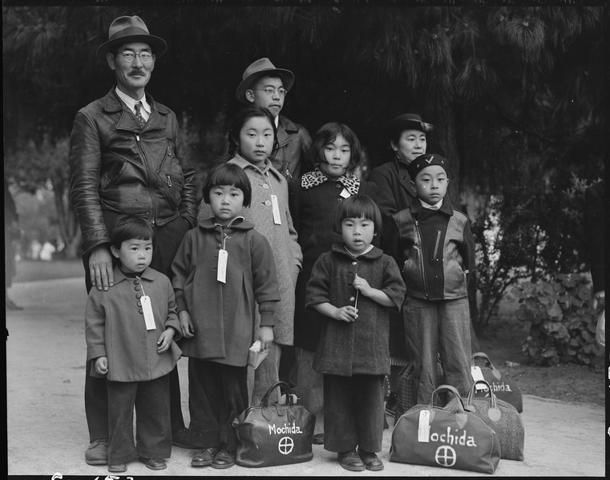 I used to tell myself in the camp that my only crime was my face. But now, when I look in the mirror, I remember what a friend once said: “When I first met you, Mary, I just couldn’t get over the novelty of your Japanese face. Strange that an American like you should look like that. First it was ninety percent strangeness and novelty and maybe ten percent friendly interest. About the second time I saw you, it was fifty percent novelty and fifty percent friendliness. Now I being to notice less what you look like and to know more what you really are. Pretty soon I’ll forget what you look like altogether. I’ll know you only as another fellow American.” (Mary Oyama)
Judgment without Trial
The army and the War Relocation Authority (WRA) proceeded to develop legal justification for incarcerating Japanese Americans outside of the War Defense Command’s military exclusion area. The government’s approach was simple: it categorized all WRA relocation centers as proscribed military areas under the authority of EO 9066. Thus, the military had the power to prevent any person brought there from leaving. (Tetsuden Kashima)
Moving Images
Even when Dorothea Lange wrote extensive captions explaining the content of her photographs, those descriptions were often modified or simply overridden by the War Relocation Authority (WRA). For instance, this photograph is a representation of the moment when the government attempted to strip Japanese Americans of their identities as individuals, reducing them to a racial identity and then sanitizing that identity with the substitution of a number for a name. The WRA abridged Lange’s caption, however, and under the “data” entry wrote, “Just about to step into the bus for the Assembly Center.” (Jasmine Alinder)
Desert Exile
 Erik M. Bachman